Showing posts with label Book Review. Show all posts

Friday, September 23, 2011

"Tales of a Sixth Grade Muppet" Book Review

By Kirk Scroggs
Available at Wal-Mart, Target, and wherever books are sold
Book Review by KC Silva

KC Silva - Here’s a News Flash for anyone who still thinks kids’ books are just for kids: Hardly. In fact, grown-ups are more likely to get the biggest laughs from Kirk Scroggs’ newest book than readers in its presumably-target tweener age group. Grown-ups, that is, who are ardent Muppaphiles!

Scroggs' previous credits include an entire series of children’s books centered around "Wiley and Grampa," a full listing of which can be easily found on Amazon.com, but his newest, "Tales of a Sixth-Grade Muppet,"  is both a stand-alone story and an obvious tie-in to all things Muppety in honor of the upcoming film. Done in the part-text, part-cartoon narrative style made popular by the "Wimpy Kid" books, Scroggs proves he is wittier and a better artist than the author of that series, and draws laughs easily from any reader familiar with the Muppets. That said, don’t give this book to your 11-year-old nephew in the hopes that he’ll suddenly become a raving Muppet fan. The story presumes readers are already somewhat familiar with Kermit, Piggy, Muppet Labs, and of course the narrator’s hero, the Great Gonzo; but given that, any Muppet fan will find plenty to enjoy.

Although all of the Muppets are well written, the only character development takes place with the narrator, a sixth-grade outcast named Danvers Blickensderfer, who copies the insanely dangerous stunts of his idol Gonzo, ostracized by his classmates, harassed by his kid sister ("evil incarnate," claims Danvers), incomprehensible to his parents, and wishing desperately to be a Muppet. Of course, this being both children’s literature and a Muppet book, he gets his wish, waking up one morning inexplicably Muppetized. However, enjoying the fuzziness and quick recovery time after injuries which all Muppets are privileged to doesn’t mean Danvers’ social life becomes any easier...
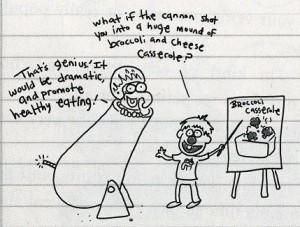
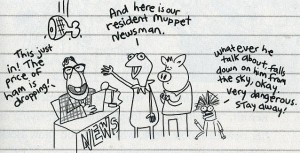
What really makes this book a blast are the cartoons. Scroggs combines not just text narrative and childish doodles (which are supposed to be Danvers’ own drawings) throughout the book, but frequently includes comic-book-style illustrations... and those are often the best jokes in a book full of good ones! Even the one-liners he tosses off in these drawings are hysterically funny: a running gag about his little sister Chloe’s obsession with the Fluffleberries ("the world’s most diabolical children’s TV celebrities"), a gag about his school lunch lady, Gladys, Beaker "Meep" jokes, a mock-Billboard Top 10 list of the hit songs by the boy-band group Emo Shun... The most admirable things about these casually tossed-off jokes within larger cartoons are how well the drawings flow in the narrative; rather than simply complementing the story, most of them are integral to it, and it works extremely well.
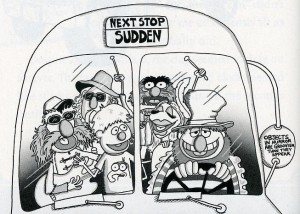
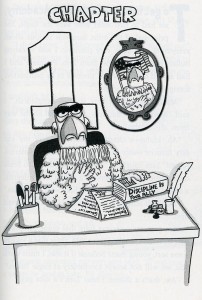
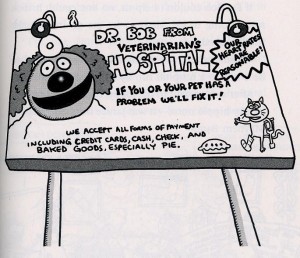
As far as the Muppets themselves go, Gonzo is the focus of Danvers’ attention, but Piggy gets plenty of time, as do Bunsen and Beaker, Pepe, Kermit, the Electric Mayhem, and the cast of "Veterinarian’s Hospital." Other characters are featured several times, such as Rizzo, Sam the Eagle, Statler and Waldorf (who begin showing up, randomly heckling Danvers–guess that’s part of the whole territory of being a Muppet), Animal separately, Fozzie, and others. Almost everyone gets at least a cameo drawing, and the drawings are comic in all senses! Scroggs nails the persona of each Muppet he includes, even if they have only a few lines; it’s obvious within just the first couple of chapters that the author is a Muppet fan from way back, and whether kids or adults, he’s aimed this work at fellow fans who’ll get the in-jokes as well as the sillier ones.
There’s also a bit of satire: the aforementioned Emo Shun are antagonists of a sort, competing for fame alongside some of the Muppets in a "Fall on Ice" show, and every mention of the boy-band will tickle every hater of bland-as-white-bread teen pop singers. As an example, the list of hits garnered by Emo Shun includes such memorable tunes as “You Put My Heart in Detention, Girl” and “Girl, You Treated My Heart Like a Yo-Yo, Yo.” Piggy judging the entrants for the ice follies smacks highly of a certain ridiculously popular American talent show. The Fluffleberries movies are rated “G-5: Viewing this film could cause irreversible brain damage to anyone over the age of 5.” Though such snickers aren’t major plot points, they assuredly raise a grin and add to the entire atmosphere of the story.
Danvers, for all his social-outcast status, is nevertheless a witty observer of modern pop culture–something I believe is integral to Muppet fans in general, as the humor of Henson and Co often relied on the juxtaposition of social mores with absurd parodies of those same superficial "values." It’s clear the Muppets strongly influenced Kirk Scroggs’ outlook on life, and he does tribute to them extremely well... even in a book marketed for kids.

Dozens of Muppets, hundreds of good jokes and witty drawings, a main character every Muppet lover can identify with, an unexpected ending. Four out of five stars (only because I wished for a little more depth to the plot). Check it out!


The Muppet Mindset by Ryan Dosier, ryguy102390@gmail.com

Friday, February 11, 2011

The Diary of an Obsessed (British) Muppet Fan


Dear Diary,
TBC - No real picture available
I imagine you were wondering why it is that Ryan has not been spending much time with you lately...well, is it not obvious? I kidnapped the feature in order to attempt a subtle but effective blackmail take down of Ryan so that, finally, the blog would be completely mine mine MINE! But, as usual, I have been foiled by the unexpected openness of the American boy who insisted on A. Filling his diary with some sort of DVD reviews and B. Publishing these inserts publicly thus rendering any attempt to blackmail him with his diary useless.

But never mind that.

I am on to plan B and holding you, oh precious diary, ransom.

Which reminds me...(Cue flashback)...there is something else that I have been holding ransom for quite some time. It is a small book with a long title, available in hard-back from just $11.53 on Amazon.com containing interesting snippets, helpful pick-up lines and some dubious back-story as told by the Muppets own resident king prawn, Pepe.

The book, It’s Hard Out Here For A Shrimp: Life, Love and Living Large, has a flashy cover with a fancy image of Pepe immersed in water with a nice bright blue sky background. (And how DO they do that! I mean, he is a puppet, surely he cannot get wet? Gosh! Technology these days, I ask you.) The book contains witty advice on how to live your life the Pepe way and is a quick read that can easily be completed in one sitting (although this depends on your definition of one sitting since I keep one copy in my guest bathroom).


The book is divided into sections such as Love (“First love is the best, followed by second love, then third, then fourth, then... you get the idea, okay.”), Family (“I owe my family everything, with interest.”), Friends (“Keep your friends close, your enemies closer... and your girlfriend away from them both.”), and Monies (“If there was such a thing as easy money, I wouldn’t be writing this book.”). Each section then contains pithy witticisms in the style of a self-help guide, although in Pepe’s case it could be more of a "help yourself" guide. See? I made a witticism! And they say the British are not pithy...

I personally found the book funny enough to raise a smile on each page, but felt that it did not quite reach the point of laugh-out-loud humour; however, the book provides a valuable insight into Pepe’s mind and forms a great conversation starter after guests have used the convenience.

Wait a minute!

I see what is happening here. Somewhere along the way this diary entry morphed into a book review! I was only trying to tell you about the time I held the book ransom until my aforementioned guest washed their hands! Sheesh.

Anyway... I must message Ryan that I have his book and that if he does not wish to receive a torn out page in the post as proof then he better start handing me the keys to that blog of his.

Until next time.
-The British Correspondent


The Muppet Mindset by Ryan Dosier

Saturday, February 13, 2010

Sesame Street Saturdays: The Sesame Street Book Brawl


The Three Greatest Sesame Street Reference Books!
Michael Wermuth, Jr. - The three best Sesame Street reference books are, without a doubt, Sesame Street Unpaved, Street Gang, and Sesame Street: A Celebration – 40 Years of Life on the Street. All are good, and while some info is repeated among them, they also stand on their own, and are good companions to each other. But suppose you can only have one of the three (never mind the fact that Sesame Street Unpaved is long out-of-print, and the other two are still in stores). Which should you choose? Well, I’ll talk about the differences between them, to show which one might interest you the best.

First of all, if you are interested mostly in the characters and classic moments, then Sesame Street Unpaved: Scripts, Stories, Secrets, and Songs by David Borgenicht is the best choice. That one seems to have the most focus on characters and moments. In addition to a chapter devoted to the cast, the chapter on classic moments (the longest chapter in the book, too, I might add) groups many classic moments by major Muppet characters. There are a number of additional sketches represented between character sections, most of which are animated songs from either Jim Henson or Budd Lucky, and there’s a section on interactions between Muppets and kids (most of them feature Grover, but it also includes the classic where Kermit and a girl named Joey recite the alphabet). Many classic sketches are represented in script form, with several still images from the segments. Most of Guy Smiley’s game shows are more-or-less represented as profiles. There are also “Do you remember?” recaps, describing (as opposed to scripting) a number of segments.

And in addition to the very long chapter on classic moments, there is also a song chapter, though a number of song lyrics appear in the classic moments chapter (and the section on “Would You Like to Buy an O?” also includes a listing of items Lefty has tried to sell, followed by a script of the “Golden An” segment).  This one probably has the least amount of focus on “behind-the-scenes” facts, but there are plenty sprinkled throughout the book. There’s a “Behind-the-Scenes” section, which includes biography pages on seven of the shows main performers in addition to a page listing performers and their characters. The cast section has pages on the human cast, describing the characters and their portrayers equally. Most sections on Muppet characters mention their performers (though the section on supporting Muppet characters generally only gives one mention of performers per character). Unlike the other two books, this one doesn’t really mention any outside Sesame Street productions. This is also the smallest of the three books, and not just because of the long gap between this and the next two books.

Street Gang: The Complete History of Sesame Street by Michael Davis has the most coverage of the show’s pre-history, though in my opinion it focuses too much on the pre-history of the show (the pre-history probably takes up more than half the book). It also includes a lot more focus on the people who worked on the show than on the characters itself (though there is plenty of mention of the characters). Usually when somebody is mentioned the book goes on to discuss them, even if they don’t have anything to do with the show. A lot of the pre-history stuff is interesting (especially the children’s shows that came before Sesame Street), but would better belong in separate books. While I appreciate that the first ten years of the show get the most focus, I am disappointed that the remaining years are rushed through. So much for being about the “complete history” of the show (“The Complete Pre-History of Sesame Street” would be a more appropriate title).

Finally, there’s Sesame Street: A Celebration – 40 Years of Life on the Street by Louise Gikow. It’s perhaps the best for those wanting behind-the-scenes information. Almost every performer gets mentioned, as do most of the human cast, both past and present. The characters are featured throughout, but those character-specific sections are sparse. Some of the performer pages have short sections on certain characters, and there are pages representing Big Bird and Oscar, Bert and Ernie, and Elmo, and there is a section about characters who have come and gone.

Those wanting to know more about the show’s animation should check this one out as well. Sesame Street Unpaved included images and lyrics from several animation and film inserts but with the exception of Jim Henson didn’t really acknowledge any of the show’s animators or filmmakers, and didn’t provide any special facts on any non-Henson film/animation inserts. Street Gang also hardly mentions any specific animation, with the only animation/film focus being on Jim Henson’s contributions and some of the stuff from the first week. But this book has a big chapter on many of the show’s animation and film inserts, and discusses many of the filmmakers and animators.

Interestingly, very few individual moments get represented in all three books. There are a few that are discussed or presented in script form in all three (the adults explaining Mr. Hooper’s death, Luis and Maria’s wedding, "Rubber Duckie," Jim Henson’s “Baker” films), but for the most part the majority of segments and episodes represented are only represented in one of the three books.
In conclusion, all three books offer a great read for different reasons. But if you had to pick one, it seems the most recent, Sesame Street: A Celebration - 40 Years of Life on the Street, is the best to choose.


The Muppet Mindset by Ryan Dosier

Sunday, November 1, 2009

Sesame Street: A Celebration - 40 Years of Life on the Street Book Review


Sesame Street: A Celebration -

40 Years of Life on the Street
by Louise A. Gikow


Ryan Dosier
-
304 pages. 41 photographers. 15 chapters. 4 introductions. 1,100 pictures. 1 television show. 4,212 episodes. 40 years. 1 of the greatest books of all-time celebrating the greatest television show of all-time.

Even Count von Count would be given a run for his money with Sesame Street: A Celebration - 40 Years of Life on the Street by veteran Muppet and Sesame Street employee Louise Gikow. This massive, hardcover book exploring, in incredible detail, the 40 years that Sesame Street has been changing the world as we know it is quite possibly the greatest piece of Sesame Street merchandise produced for the 40th Anniversary--perhaps of all-time.

Everything you have ever wanted to know, every picture you have ever wanted to see, every cast, crew, and Muppet bio you have ever wanted to read--they are all here in incredible detail. It is nearly impossible to truly comprehend every single shred of information presented in this book. I have examined every page four times in the two days I have owned the book and there are still chapters I haven't read, still pictures I still haven't dwelt nearly long enough on, still stories I haven't laughed at, still quotes I haven't been left stunned by, still magic that hasn't touched my heart and soul in the way only Sesame Street can.

Every chapter of the book starts out on the set of the most famous Street in all the world--usually during the filming of an episode from the 40th season. These sections are beautiful and real and it feels like we, the undying fans of the show, are actually sitting in a director's chair watching Elmo, and Big Bird, and Abby Cadabby goof around between takes. Each chapter then segues into a discussion of the past 40 years of the show. Every chapter follows this trend, just with a different theme each time.

Scattered throughout every single page of the book are photographs of countless men, women, monsters, birds, dogs, Ernies, Berts, grouches, Counts, frogs, Snuffleupaguses, celebrities, and much, much more. The sheer amount and quality of the images here boggles the mind. Never before has such a revolutionary amount of never-before-seen Sesame Street photos been collected and put into one place.

There are at least 50 pictures of Susan, Gordon, Bob, Maria, Luis, Mr. Hooper, Oscar, Big Bird, Bert, Ernie Elmo, Grover, Cookie Monster, and more; at least 30 pictures of Kermit, Snuffy, Prairie Dawn, Caroll Spinney, Jim Henson, Frank Oz, and Jerry Nelson; at least 20 of Barkley, Herry Monster, Fat Blue, Richard Hunt, Fran Brill, and Martin P. Robinson; one picture of both Mr. and Mrs. Obama; and hundreds and hundreds more of everything that represents Sesame Street and all they have done and will do in the future.

Never before has an official, invaluable resource on the scale of this been made available to the public. Everything on these pages is a call out to we, the hardcore fans of the show as kids and adults. Louis Gikow does an amazing job of writing the book as a love-letter to the fans. Every word feels so fresh and new that even the old story of how Big Bird grew out of his "big goofy guy" persona seems like brand new information.

There is just so much going on on every page in this book that it is impossible to truly do it justice in one review. There is so much information and there are so many pictures presented at every flip of the page that I could literally do a review of every two or three pages. (I won't... but I could.)

It feels as if every person, no matter how minor, who helped and continues to make Sesame Street what it is today is represented here in full. From Jim Henson and Bob McGrath to one-season actor Ward Saxton and cameraman of Sesame Street's Camera 1, Frankie Biondo, who has been shooting the Street since day one--everyone is represented.

At the end of the day, this book represents every single thing that Sesame Street stands for--every single thing it has stood for since day one: teaching, smiling, laughing, loving, embracing, understanding, and sweeping the clouds away to bring another sunny day into our lives. This book will brighten anyone's day with any page. I dare any Sesame Street fan to flip open the book to any page, see a picture of Luis and Maria dancing, Jon Stone wearing Bert as a hat, or Telly dressed as Bob, and not smile and have a day that is a little bit more sunny.

Buy this book, Sesame Street fans. A day won't go by that you will regret doing so. C'mon, for years we fans have been asking how to get to Sesame Street, and now we have another clue to the answer: read and love Sesame Street: A Celebration - 40 Years of Life on the Street.


Buy your copy of this incredible book for only $26 with free shipping from Amazon.com today!

Monday, October 12, 2009

Muppet Comic Mondays: Muppet Robin Hood #3


Muppet Robin Hood #3

Comic Book Review


Ryan Dosier – Muppet Robin Hood from BOOM! Studios continues with the third issue. In issue #2, Robin Hood (Kermit) and his Merry Men had just trashed the dinner party of Prince John (Johnny Fiama) and royally ticked off the prince (get it?).


Issue #3 was released in August, 2009.

PLOT
Issue #3 starts in the middle of a concert. Above the stage is a banner that reads “King Richard and the Crusades: The Hot ‘n Holy Tour.” We soon find out that the Crusades are really Floyd Pepper, Zoot, Animal, and Dr. Teeth. After a few bad puns (even by Muppet standards) Pepe the King Prawn is revealed as King Richard—for once the shrimp actually is the king prawn. Who’da thunk it? King Richard has been touring with the Crusades for reasons that aren’t explained very well—all I really caught was that Robin Hood left the Crusades to return to England and now he’s more popular than King Richard ever was, thus making the prawn jealous and causing him to cancel the Holy Land tour and return to England.

Just as soon as we’re introduced to the Crusades, we’re taken to a new scene. Prince John is in need of a new plan to capture Robin Hood. With the help of Sir Sal, Guy of Gisbourne (Gonzo), and the Sheriff of Nottingham (Sam Eagle), Prince John devises a trap for catching Robin Hood. After a suggestion from Bean Bunny (in a very brief, yet surprisingly funny, cameo appearance), it’s decided that an archery contest will be used to catch the thief.

Upon returning to Sherwood Forest, Friar Tuck (Fozzie Bear) informs Robin Hood and the Merry Men about the contest. They immediately realize it’s a trap, but the head-strong Robin decides to go anyway, only in a disguise. Much the Miller’s Son (Scooter), who has an affinity for sewing, agrees to make the disguise.

Now we’re back at the castle, where Dr. Bunsen Honeydew and Beaker are conducting experiments with technology that is far to advanced to have existed in the Dark Ages, but that’s beside the point. Wait… no it’s not. After setting an entire story in this time period, it feels weird to create a “Voice-Activated, Motion-Sensing Arrow.” It completely breaks the fourth wall—and not in the good way the Muppets usually do.

Anyway, Honeydew gives Prince John the arrow for the Sheriff to use in the contest and Prince John sulks into the darkness outside for some reason. Here, he meets Tuck, who tells him that Robin Hood will be in attendance at the contest in a disguise. It’s here we finally see a Fozzie-like side to Tuck who feels guilty for spying on Robin and the Merry Men. We quickly see Fozzie’s Ma being held in a dark tower as Prince John’s prisoner and we understand why he does whatever John asks.


The next day, with awful costume in hand, Robin and the Merry Men abscond to the archery contest. Some fun Muppety mayhem ensues for the first time at the archery contest. Robin Hood flirts with Maid Marian (Miss Piggy) and is totally rejected again—no matter, though! He’s Robin Hood! The Sheriff gets heckled by the crowd and completely misses his shot, and Robin wins.

But, of course, this is a victory that ends with Robin being captured by the Prince’s guards and tossed in the dungeon.

TONE
The tone in issue #3 is better than the previous two issues of Muppet Robin Hood. We finally get to see some Muppety fun at the archery contest—unfortunately it only lasts a few pages. The rest of the story still feels weird and unfunny. I do like the sympathy we get to feel for Tuck when we find out Prince John has his Ma, but other than that the tone remains all wrong.

Actually, thinking about it more, I think I’ve figured out what’s wrong. All of the characters are rude. King Richard is a total jerk to Dr. Teeth and he just takes it—Dr. Teeth would not take that. Even Kermit plays the jerk a few times in his fights with Gonzo and Sam. Kermit should never play the jerk.

WRITING
The writing here has improved slightly. I still have my gripes about the way Tim Beedle writes Kermit, Sam, Gonzo, Sweetums, Robin, and Miss Piggy—and now I can add on that I really despise the way Pepe, Bobo, and the Electric Mayhem are written.

I do, however, like how Johnny, Sal, Fozzie, Bunsen, Clifford, George the Janitor, and Pops are written. I suppose that may look like the good outweighs the bad, but most of the characters that I like are too minor to really make an impact.


I just don’t really understand some of the things some of the characters say. Yes, this is the Muppets playing the Robin Hood cast, but they don’t have to say things that are so uncharacteristic to their personalities. Sam loses his temper twice in this issue for ridiculous reasons—Tim Beedle doesn’t seem to understand that Sam only loses his temper as the last straw. He just gets annoyed and disgusted by the Muppets, not so angry that he spits.

Sam is just one example of the bad writing/characterization given here. It’s really a shame.

ART
The art continues to be the worst part of every issue. These grievances are meant as no insult to artist Armand Villavert, Jr.’s talent—he really is a very good artist—he just has no sense of what the Muppets should look like at all.

Clifford looks like a woman in two panels and an eel in the rest, I can’t tell the difference between his Piggy and his Annie Sue, his Scooter’s head is misshapen, Beaker looks like a cocaine addict, Floyd looks like a demon in one frame, and Dr. Teeth looks like a hobo and doesn’t even have glasses.


Pepe, Animal, Bobo, Bean, and Pops look okay though. Oh, and Crazy Harry and George the Janitor are spot-on perfect. George even does archery with a mop—one that Crazy Harry quickly blows up. That was a highlight. Too bad it only took place in four frames all together.

CONCLUSION
While I do support the Muppets in all of their comic book under-takings, if you’re going to skip one of them, Muppet Robin Hood is the one to skip. It pales in comparison to Roger Langridge’s The Muppet Show Comic Book and Grace Randolph and Amy Mebberson’s Muppet Peter Pan. Both of these books are so vastly superior to this that it’s almost unfair comparing the two.

If you do want to buy it, however, buy the trade paperback containing all four issues of Muppet Robin Hood here!


CAST

Kermit the Frog as Robin Hood; Miss Piggy as Maid Marian; Gonzo the Great as Sir Guy of Gisbourne; Sam Eagle as the Sheriff of Nottingham; Fozzie Bear as Tuck, The Fool; Sweetums as Little John; Robin the Frog as Squirt; Scooter as Much the Miller’s Son; Janice as Willa Scarlet; Rowlf the Dog as Alan-a-Dale; Rizzo the Rat as Arthur a Bland; Lew Zealand as Rich the Fishmonger; The Swedish Chef as himself; Mildred Huxtetter as Maid Marian’s Lady in Waiting; Johnny Fiama as Prince John; Sal Minella as Sir Sal; Dr. Teeth, Floyd Pepper, Zoot, and Animal as The Crusades; Pepe the King Prawn as King Richard; Dr. Bunsen Honeydew and Beaker as themselves; Crazy Harry, Shakey Sanchez, George the Janitor, Black Bart, Mahna Mahna, and Bobo the Bear as archers; Clifford as the archery contest emcee; Pops as the archery contest judge; Uncle Deadly as Captain of the Guard; Behemoth and Green Frackle as Guards; Bean Bunny, Ma Bear, the Snowths, Lubbock Lou and the Jug-Huggers in cameo appearances

Sunday, September 6, 2009

Street Gang Book Review

Street Gang: The Complete History of Sesame Street
By Michael Davis
Viking Books, 2009, $27.95 U.S., $31.00 Canada


Erin Roll (MuppetNewsgirl on Muppet Central Forum) - Is it really possible to do a “complete” history of Sesame Street in just one book? It would seem that there’s enough cast and crew bios, character information, trivia and taping dates to fill a set of encyclopedias.

That being said Davis gives it his best shot with Street Gang, a thorough, funny, poignant and candid look at the lives of the people who brought Sesame Street to life.

Sometimes, the book gets bogged down a little bit in background on politics and culture’s effects on the show, but Davis manages to keep it all connected to the show, more or less.

The reader gets a look at the early days of children’s television, a genre that was denounced by FCC heads in the early 1960s as “massive doses of cartoons, violence and more violence.”

The book begins with the story of four-year-old Sarah Morrissett, whose parents observed that she was obsessed with the test pattern on the family’s television. It was a fact that didn’t go unnoticed by a family friend, Joan Ganz Cooney.

Later, Jim Henson comes into the story, and the first seeds for the show are planted.

Around Chapter 14, the book finally gets to Sesame Street itself. From this point on, we are introduced to more cast members, like Emilio Delgado, Sonia Manzano and Northern Calloway, and puppeteers like Jerry Nelson, Richard Hunt, Marty Robinson and Kevin Clash.

Davis makes sure to devote some ink to Elmo’s rise to stardom, depicting Richard Hunt as walking into the green room carrying Elmo “upside down by his rod, as if he were carrying a dead buzzard by his claw (286)” and pitching the puppet in Clash’s direction.

There are some nice sections on the creation and evolution of key characters like Big Bird, Oscar the Grouch (he was originally orange), Ernie and Bert and Snuffy.

Chapter 18 is one of the more difficult chapters to read, as it deals with upheavals in the show’s dynamics and format, as well as the deaths of several key players. Plus, around this time, Sesame Street starts to see a rival, in the form of a certain overly sappy purple dinosaur called Barney.

In this chapter we see quite a bit of Calloway’s decline, slow burn and death, written in almost graphic detail. A good bit of space is dedicated to Jim and Jane Henson’s separation in the late 1980s, often in not a flattering light, and there is one poignant scene of Richard Hunt telling his sister about his illness for the first time while driving through a nighttime rainstorm.

The book ends mostly on an optimistic note, looking toward the show’s future. In some spots, Davis delivers too many details or not enough details in other spots, but all in all, “Street Gang” is a must-read for die-hard Sesame fans and casual viewers alike.


Buy Street Gang and read it for yourself today!

Thursday, September 3, 2009

Kermit Culture Book Review (and Where's My Frog?)

As reported yesterday, Miss Piggy appeared on America's Got Talent last night. A green thing with ping-pong ball eyes was also there with her. People referred to it as Kermit, but I refuse to call him that entirely on the grounds that he wasn't performed by Steve Whitmire. I don't know what happened or why it wasn't Steve--fans are hoping that he was sick (that sounds AWFUL to say...) or otherwise just unable to make the shooting or pre-record the material for some reason--but we just don't know. Whoever was Kermit was extremely brave for attempting this, but that's all it was. An attempt. That was NOT Kermit the Frog. That was NOT Steve Whitmire, who has been Kermit for nearly TWENTY years. Muppet fans are clammoring for information, so if anyone out there has any I implore them to make it known on The Muppet Mindset, Tough Pigs, Muppet Central, or The Muppet Newsflash SOON. For now... here's Tough Pigs' article on the insanity, and the YouTube video of the performance. I promise that as soon as I know any information at all on who this fake-Kermit was, why this fake-Kermit was, or anything at all... it will be made known here on the Mindset. My thoughts are with Steve Whitmire now, whatever he may be doing. I don't know about anyone else, but I desperately need a new Muppet appearance WITH Steve--and very, very soon.

Our featured article today is by guest writer Arianne Gallagher. She brings us a review of the book Kermit Culture. Enjoy!


Kermit Culture: Critical Perspectives on Jim Henson’s Muppets
Book Review
Edited by Jennifer C. Garlen and Anissa M. Graham
McFarland & Company, Inc., Publishers, $35.00

(out of 5)


Arianne Gallagher (Muppetfan44 from Muppet Central Forum)
- Kermit Culture is a collection of 15 academic articles that focus on analyzing the core group of Muppet characters from The Muppet Show and all the feature films, including Muppets Wizard of Oz (why that’s included as a feature film, I have no idea!). The book is divided into three parts. “Audience Participation” contains articles that examine the relationships between the Muppets and their audience; “Adaptation and Performance” contains essays that analyze the Muppets as characters that are performed, as well as actors themselves who bend cultural lines, re-defining them. The last part, “Theories and Strategies” contains articles that explore the Muppets and their work through different topics, such as the Muppets’ national identity, educational value and gender roles.

When I first discovered that this book was going to be released, I was ecstatic. It appears to be a Muppet fan’s dream: a book full of articles analyzing the Muppets on an intellectual level. How many of us have written essays and articles for our classes based on the Muppets while only receiving awkward glances from our peers? (Guilty!) Now we can look back on those moments and smile, because hard-core Muppet fans much like us got together and actually published their articles, justifying our own academic endeavors with the Muppets.

However, I couldn’t agree more with Dr. Teeth, who is quoted at the beginning of the preface with his famous line from The Muppet Movie, “This is a narrative of very heavy-duty proportions.” Even though the book is only 216 pages long, it’s a very heavy read with a lot of academic jargon that can take even the best reader weeks to get through. The articles are grouped nicely into the three parts, but the book as a whole does not flow easily throughout, which can be expected to a degree, considering it’s a collection of articles. The main thing I did not like about the book is that many of the articles are filled with the aforementioned intellectual jargon with little or no explanation as to what they’re getting at.

For example, in “Stuffed Suits and Hog-Wild Desire”, Lynn D. Schneider describes Statler and Waldorf’s theater box as: “Linear qualities commingle with nonlinear qualities: commodities, earnings, and predictable Newtonian ‘causation’ mix with color, light, harmony, and movement.” What the heck does that mean? McFarland publishing advertises that this book is for academics as well as fans and the common reader, but what can fans and the common reader get from sentences like that, which sound like they’re in another language and don’t fulfill any purpose for the article as a whole? I would definitely have to say that the main problem with the book is that it is overall difficult for the reader to connect with and understand fully what the author is trying to say. It automatically frustrates the reader by putting them on a different plain from the authors, and you feel like you don’t get your money’s worth, especially since the book costs about $40 with shipping.

There were also times when I did a double take when reading some of the things the authors were trying to argue. In, “The American Journey Narrative in the Muppets Movies”, Tara K. Parmiter takes an intense look at the running gag in the The Great Muppet Caper where Kermit and Fozzie are identical twins in terms of journey narratives, stating the importance of being able to distinguish one’s self from others. She states, “If Fozzie can’t recognize his own physical appearance, how likely is he to understand his own individuality?” the article as a whole is fantastic, but there are moments like these in this article and the others where the authors put way too much into some of the skits and scenes that are merely part of the Henson brand of silliness and comedy. Fozzie and Kermit being identical twins is just one of the many running gags that are part of the Muppet portfolio of jokes, not an examination of self-identity. Yorrick trying to eat Kermit during the “I’ve Grown Accustomed to your Face” lip-sync on The Ed Sullivan Show is just one of the many bits where the Muppets fill the comedic void by having one character eat the other, not something to examine, “in light of postmodern feminist and queer criticism of rape and violence directed at drag queens, drag kings, and transsexuals, and the transgendered” as Kathleen Kennedy describes in her article, “It’s Time to Get Together for Some Sex and Violence on The Muppet Show?” I know these are academic articles that are analyzing the Muppets intellectually, but some things really just are jokes and Muppet silliness designed only to entertain, and there are times, in my opinion, where the authors go a little far in their explorations of these skits and scenes.

Despite some of the frustrations I had while reading the book, either trying to understand what the author was trying to say or understanding why there were overanalyzing simple components of Muppet culture, the book contains lots of literary gems. “Gonzo, the (Great) Cultural Critic” by editor Jennifer C. Garlen contains a fascinating look at how Gonzo’s perception of culture on The Muppet Show slowly gets accepted by the audience and the guest stars, while Sam the Eagle’s perception of culture gets rejected even though he generally portrays the traditional view. There are also wonderful descriptions and characterizations of the Muppets throughout the book. For many Muppet fans, we know we love the Muppets but have difficulty describing why or how much the Muppets really impact us. Ben Underwood recognizes this in, “How to Become a Muppet; or, the Great Muppet Paper” when he states that, “many fans regard the Muppets as embodying an important message. Most of these fans would be hard pressed, however, to explain what that message is.” Many of the authors capture the way many people feel about the Muppets perfectly and provide us with phrases to express the aspects of the Muppets that we love so dearly. Julie G. Maudlin provides us with one of these phrases in “The Muppet Show as Educational Critique”: “In spite of the gratuitous explosions and excessive nonsense, there is a certain nostalgic sweetness about the Muppets, an implicit compassion that seems to undergird the chaos”. Tara K. Parmiter also gives us one of these “Kodak moment phrases”: “Jim Henson and company remind us that home need not be centered in place but can be found in community… the Muppets assure us that our journeys need not keep us away from those we love. At journey’s end, the Muppets always know that they have not returned home, but have found it. As Kermit puts it in the last line of The Muppets Take Manhattan, ‘What better way could anything end? Hand in hand with a friend.’ What better way could the journey end?”

The other literary gems I discovered were found in the Works Cited sections of many of the articles. If you think it’s surprising that now there’s a whole book of academic essays about the Muppets, some of the articles cite other academic articles in which to wet your appetite of Muppet criticism. Titles such as, “a Weirdo, a Rat, and a Humbug: the Literary Qualities of The Muppet Christmas Carol” and “The Performance of Nonconformity on The Muppet Show—or, How Kermit Made Me Queer” are more than enough to spark the curiosity of any reader to find out more. I know that I plan to find some of these other articles to add to my pleasure reading list.

All in all, this book has its hits and misses throughout, but a reader can really appreciate it for what it is: a bunch of articles written by Muppet fans. Their love of the Muppets comes through clearly in the text, even though some of their ideas don’t. It’s a long and difficult read, but worth the time. It is a little pricey, but if you get a chance to splurge it’s worth having on your bookshelf. Hopefully more collections of essays like “Kermit Culture” will be developed and maybe some of us Muppet fans will get to publish our own scholarly articles and “Great Muppet Papers” after all.

Order your own copy of Kermit Culture today!

Tomorrow on The Muppet Mindset: An exclusive interview with veteran Muppet writer Jim Lewis!!

Wednesday, August 26, 2009

Jim Henson's Doodle Dreams Book Review

Jim Henson’s Doodle Dreams:
Inspiration for Living Life Outside the Lines
Book Review
Art by Jim Henson and Text by Jim Lewis
Meredith Books, 2008, $12.95


(out of 5)

By Ryan Dosier - Everyone knows that Jim Henson was a visionary, a genius, an inspiration—an artist. But what only some appreciators of Jim Henson’s work know is that he truly was an artist; someone who doodled haphazardly, scribbling the things that just couldn’t escape his bustling mind. It’s probably safe to say that these doodles were how Kermit, Big Bird, and the other Muppets were all first conceived.

It’s obvious, then, that a book of Jim Henson’s doodles would be released so that the world can delight in his mind’s wonderings (and wanderings). That book is Jim Henson’s Doodle Dreams. An inspirational sort of self-help book, it features pages of Henson’s doodles coupled with quips and clever captions by veteran Muppet writer, Jim Lewis. As Lewis says in his introduction to the book, “As for the words, they are my attempts to capture Jim’s spirit.” So while the words in the book were not spoken by Henson himself, Lewis feels that they capture the essence of who Jim was—just as the doodles do.

WRITING
As someone who has read countless numbers of Jim Henson quotes, I can easily say that Jim Lewis has done a fantastic job of illuminating Henson’s spirit and meaning. Some of the quotes sound like things Henson would have actually said. Things like “Be interested in everything” (coupled with a doodle of a man with a butterfly net chasing a flying blue fuzzy), “Try to instigate silliness” (coupled with a goofy looking monster doodle), and “You are where you are because that’s where you need to be. And if you need to move on, you’ll move on” (partnered with a picture of a business man) all seem like quotes that could be pulled from a book written by Henson himself.

ART
What could there possibly be to criticize about the artwork of Jim Henson? His doodles are quirky and silly—just like he was. Some of them, such as a beautiful watercolor of a turtle ascending a hill, seem deep and profound—even if they may just be quick doodles. All of the drawings are fun and irreverent and very, very Henson. A great selection of work—most of which I had never seen before—which really highlights the book.

OVERALL
My only complaint about the book is that it’s simply just too short. There are probably thousands of Henson’s doodles lying around in the Jim Henson Legacy’s file cabinets—surely more of them could’ve been included.
But past that one small grievance, this book is truly marvelous. Jim Henson’s Doodle Dreams is a must-own for any Muppet fan, Henson fan, or just someone in need of a smile. Jim Lewis’s words partner with Jim Henson’s artwork wonderfully—a truly commendable feat.
This book is inspiring in a way that only Jim Henson could be. His immortal words keep ringing through my mind while reading this book—“Keep believing, keep pretending” and, if I may add, keep doodling.

Order your copy of Jim Henson’s Doodle Dreams today!

EXCERPT
“Understanding other points of view keeps you fresh. You can look at the same thing one way forever, and it never seems to change. Then someone comes in and turns it upside down or inside out and suddenly, together, you’ve made something amazing.”